
Round or Square Button Badge Maker: Which Should You Start With?
My heart says square. My head says round! Discover my experience with both button badge makers and what to consider when choosing your first machine.
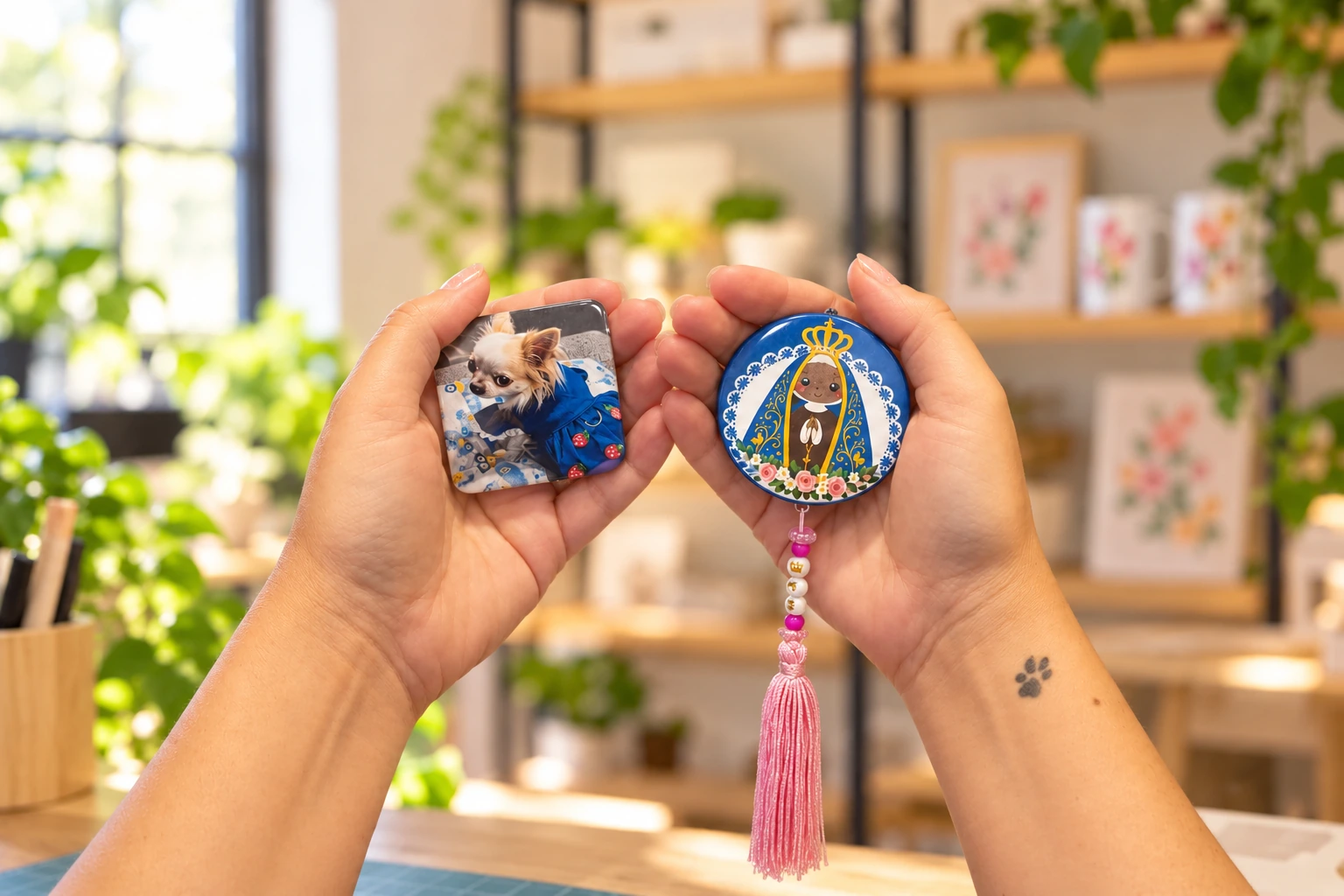
When someone asks whether I recommend a square or round button badge maker to get started, I usually answer with another question:
“Do you want the answer from my heart or from my head?”
My heart says square. My head says round.
Let me explain!
I fell in love with the square machine after watching a video on social media. I could already imagine my designs and photographs becoming magnets, finding a place in someone’s home and memories.
The round machine only came into my life later, while I was watching other videos and looking for supplies to restock. Once I discovered its possibilities, I realized how many different products I could create.
That is why, today, I would recommend a round machine to someone who wants to start by exploring a wider variety of products.
But the square machine still has a special place in my work—and in my heart. The choice depends on what you want to make, so let me share what I have learned from using both.
The square machine won me over with its simplicity
In my experience, the square machine is easier to use. I found it intuitive, which helped a lot when I was getting started.
With it, I make:
Pin-back badges;
Magnets;
Mirror keychains.
Photo magnets were what first caught my attention. I love thinking that a thoughtfully chosen image can be right there, in view, every time someone opens the fridge.
If you mainly want to create photo keepsakes, the square format is worth considering.
I usually find it easier to fit the photos I receive into a square, although the image still needs to be adjusted to the printable area.
The round machine opened up new possibilities
When I discovered the round machine, I began to see how many different products I could make.
With the equipment, dies, and supplies I used at that stage, I made:
Pin-back badges in 32, 44, and 58 mm;
Simple keychains in 32 and 44 mm;
Mirror keychains in 58 mm;
Double-sided button keychains using 44 and 58 mm pieces;
Bottle opener keychains.
This variety allowed me to put together a selection of samples for different occasions and customers.
And that is where your imagination gets going: one design can become an accessory, a party favor, or a useful gift.
That variety is why I recommend a round machine to anyone who wants to try making different products.
Only later did I discover that round fridge magnets were also possible with the right components. That discovery deserves an article of its own, but I’ll mention it here: fridge magnets don’t have to be square!
Before buying, check which dies and components are compatible with your chosen model. The press alone cannot make all these products: each one requires the appropriate supplies and accessories.
Which is easier to use?
Of my two machines, the square one wins on ease of use.
The round machine requires more attention to the positioning of the artwork and the backing component. The orientation of that backing in relation to the artwork determines whether the finished badge sits straight or crooked. In my process, I make reference marks to help with alignment.
Another consideration is making sure the dies are properly seated in the machine to avoid damaging the locating pins. This is important with the equipment I use, always following the manufacturer’s instructions.
Cutting becomes easier with suitable tools. To make the job simpler, I recommend a circle cutter for round designs and a guillotine paper cutter with a corner rounder for square designs, following the cutting dimensions required for each model.
Careful artwork preparation, cutting, and backing placement make assembly easier and improve the finish.
How much did I invest in each machine?
When I bought my square machine, I paid R$756 in Brazilian reais, including the machine, shipping, and import taxes.
The round machine cost approximately R$500.
Those were my purchase prices at different times and under different conditions. They are not current prices or a comparison of kits containing the same accessories.
Along with the press, you need to check what the kit includes and what must be purchased separately: dies, components, cutting tools, and starter supplies.
The cost that matters is the total for everything you need to make the products you plan to offer.
Supplies are part of the decision, too
One thing I learned was to look beyond the machine itself:
“Will I be able to restock the supplies for the products I want to sell?”
In my searches, components for round pin-back badges are usually easy to find. Some supplies for mirrors, keychains, and especially 58 mm bottle openers take more searching.
With square components, I initially found more options outside Brazil. Over time, I began finding local suppliers more easily, along with less expensive options.
Another topic that raises questions is square components with solid or cutout backs.
Before buying, confirm that the component is compatible with your machine and die. Its appearance or shape alone is not enough to make that decision.
That check helps prevent buying supplies you cannot use.
Photos, wording, and illustrations: shape makes a difference
For photos, I generally find the square format easier to work with.
With a round design, you need to pay closer attention to framing. A photo of people of different heights may leave someone too close to the edge. If several people are standing side by side, it may be impossible to fit everyone without making their faces quite small.
Sometimes I use AI to help adapt the background or composition. Even then, I review the result to preserve the people and the important details in the photograph.
Wording and illustrations usually give me more freedom to arrange elements in either format.
Before choosing a shape, I think about what needs to appear on the piece—and what must not be left out.
What do my customers ask for most?
In my work, demand is closely connected to the occasion.
For Teachers’ Day, breast cancer awareness in October, and men’s health awareness in November, for example, I receive requests for keychains or round pin-back badges.
For Father’s Day, bottle openers become popular. For photo keepsakes, square magnets are often the choice.
This showed me that each format can find its audience. Variety helps, but knowing the kinds of orders you want to fulfill also guides your choice of a first machine.
So, which should you start with?
If I were starting today and wanted to build a varied sample collection, I would choose the round machine first.
Being able to work with different sizes and finishes greatly expands the creative possibilities.
But if my focus were square photo magnets, the square machine would still make sense for that goal. That is how I started, and it remains part of my work.
To make your choice easier, think about what you want to produce:
Want to experiment with different sizes and products?
The round machine gives me more possibilities in my work and lets me explore different types of pieces.
Are square magnets and photo keepsakes your focus?
The square machine suits that purpose well and usually makes photo framing easier.
Would you prefer to start with a more intuitive assembly process?
Of my machines, I found the square one easier to use.
Want to build a varied sample collection for different occasions?
I would start with the round machine because of the range of sizes and finishes I can offer.
There is also a heart-shaped format. I see it as a more specialized option, with demand depending heavily on the occasion and customer base.
And before my opening joke causes any confusion: when I say my answer comes “from the heart,” I still mean the square machine!
You don’t need to start with every shape. You can choose one, learn the process, show your creations, and expand your options as you get to know your customers.
I started with square because I fell in love with it. Round came later and broadened my perspective.
The best first choice is the one that fits the products you want to make, the investment you can afford, and the customers you want to serve.
Want to see some of these possibilities? Explore Crica Studio’s personalized badges, magnets, and keychains, and get inspired by the different shapes.